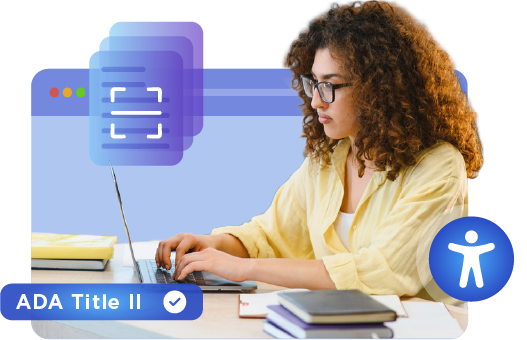
Every public college and university in the United States faces a hard deadline of April 26, 2027: its websites, apps, and digital documents must be usable by students with disabilities, or the institution risks federal complaints and litigation. ADA Title II compliance means meeting Web Content Accessibility Guidelines (WCAG) 2.1 Level AA.
The Department of Justice (DOJ) extended the original 2026 ADA Title II deadline by one year on April 20, 2026, but changed nothing else; the standard, the scope, and the underlying duty of equal access all still apply. Course content has no exception. Strip away the legal machinery and the point is simple: a student who is blind, or who navigates by keyboard, should be able to register for classes, read the syllabus, and submit an assignment without hitting a wall the rest of the class never sees. That is what all of this is really about.
Did the ADA Title II deadline actually move?
Yes, by exactly one year. The DOJ published an interim final rule on April 20, 2026, four days before the original deadline, extending the compliance dates in its 2024 Title II web rule. Entities serving 50,000 or more people now have until April 26, 2027; those under 50,000, along with special district governments, have until April 26, 2028.
Nothing else moved. The standard is still WCAG 2.1 Level AA, and the DOJ says it fully anticipates implementing the regulation at the new dates. Two consequences often get missed: private ADA lawsuits can still be filed today—this is not a safe harbor—and several state laws mirroring the federal rule kept their original dates.
Does the April 2028 ADA Title II deadline apply to smaller colleges?
Almost never, and this is the most damaging misconception in circulation. A public entity’s population under the rule is not its enrollment or its town. It is the Census population of the state or local government it is part of.
The DOJ’s own example is a state university with 40,000 students inside a state of 6 million: its population is 6 million, and its deadline is April 2027. In practice, public university accessibility obligations run to 2027 for essentially every state institution, community colleges in a state system included. A plan built on 2028 rests on 12 months that do not exist.
What content is exempt from ADA Title II and what is not?
Title II covers everything digital the institution provides or makes available, directly or through a contract—the .edu site, the student portal, mobile apps, forms, the learning management system (LMS) and its contents, social media, and every PDF, slide deck, and spreadsheet used to deliver a service—plus every video and lecture recording, which needs accurate captions and, where visuals carry meaning, audio description. Obligations do not transfer with a purchase order, which is why WCAG 2.1 AA conformance and an Accessibility Conformance Report (ACR) belong in procurement language rather than in your backlog.
Against that, the rule sets five exceptions. They are narrower than most institutions assume, and this is the version to apply to a real inventory.
| Exception | What it actually requires | Where campuses get it wrong |
| Archived web content | All four: created before your compliance date, kept only for reference or recordkeeping, unaltered since archiving, in a clearly identified archive. | Labeling a folder “archive” without the other three. Most files marked archived on .edu sites fail this. |
| Preexisting electronic documents | Posted before your compliance date and not currently used to access or participate in a service. | The second condition. A 2019 appeal form is preexisting but still in use, so it stays in scope. |
| Third-party content | Posted by a genuinely unaffiliated party, such as a public comment on an open board. | Anything posted under a contract, or by you, is not third-party content. |
| Individualized password-protected documents | A conventional document about one specific person, property, or account. | A general notice in the same portal is not individualized. |
| Preexisting social media posts | Posted before your compliance date. | Every post after April 2027 needs alt text and captions. |
One rule governs all five: an exception removes the WCAG obligation, not the ADA obligation. If a student with a disability needs an exempt document, you still have to supply it in an accessible format under your effective-communication duty. Reading the exceptions as permission to ignore content is what turns a scoping decision into an Office for Civil Rights (OCR) complaint.
Is there an exception for course materials in Canvas or Blackboard?
No. The DOJ states it directly: there is no exception for educational course content. The platform and everything in it must meet WCAG 2.1 Level AA—syllabi, slides, readings, quizzes, recordings, and linked required reading.
The preexisting-document exception cannot rescue course files: it excludes anything currently used to participate in a program, and a syllabus in active use is by definition in use. Password protection does not help either—the individualized exception covers documents about one named person, not material shared with a class.
Could the April 26, 2027 deadline change again?
It is under active legal challenge. On May 21, 2026, the National Federation of the Blind sued the DOJ and the Department of Health and Human Services (HHS), arguing the extensions violated the Administrative Procedure Act by skipping notice and comment, and asking the court to restore the original dates. The case is pending.
The implication is asymmetric. If the extension stands, an institution that kept working is early. If a court vacates it, one that paused is immediately past due with no runway. And the people caught in the gap are not the lawyers—they are the students who still cannot open the reading. Either way a documented remediation program is the strongest position to hold, and the best defense in an OCR complaint.
Where do higher education accessibility teams get stuck?
The regulation is rarely the hard part. Three problems account for most stalled programs.
| Problem | Why it happens | What works |
| Tens of thousands of PDFs and no way to size the job | Files accumulated across decentralized departments with no inventory | Inventory first, then triage against the two exception tests above. The in-scope set is usually far smaller than the raw count, but it must be evidenced. |
| The scan came back clean and the files still fail | Automated tools detect around a third of WCAG issues, and almost nothing about reading order or alt text quality | Automated scanning for coverage, expert manual review for the failures that actually block a screen reader user. |
| The same document is remediated every semester | The exported PDF is fixed while the source file stays broken | Fix the source. Remediating downstream means repeating the work at every revision. |
In the files we audit, the most common failure is not missing tags. It is tags in the wrong order, so a screen reader announces a figure caption before the paragraph it belongs to. Automated checkers pass those files.
ADA Title II compliance: what to do in the next 90 days
Inventory your digital estate and get a real file count. Apply the five exceptions and record the reasoning, because an undocumented exclusion is worth nothing in a complaint. Start with what a student has to get through to stay enrolled: registration, financial aid, and required course materials. Then put WCAG 2.1 AA and ACR delivery into every contract renewal before April 26, 2027.
If the gap is capacity rather than knowledge, ContentA11Y remediates course content—PDFs, slide decks, and lecture recordings—to WCAG 2.1 AA and PDF/UA, with every file manually verified and screen-reader reviewed rather than auto-tagged, so the reading-order failures that automated checkers miss are actually caught.
We will check a sample of your real course PDFs at no cost and tell you how much of your backlog is genuinely in scope before you commit a budget.